Intelligence Without Creating a Surveillance Environment.
NAZR is designed around meaningful events rather than unnecessary human review of continuous footage. Gain visibility into relevant activity while keeping privacy considerations at the center.
NAZR is designed around meaningful events rather than unnecessary human review of continuous footage. The objective is to surface relevant information for care teams without turning the environment into a continuous surveillance experience.
Event-focused review rather than unnecessary continuous human review
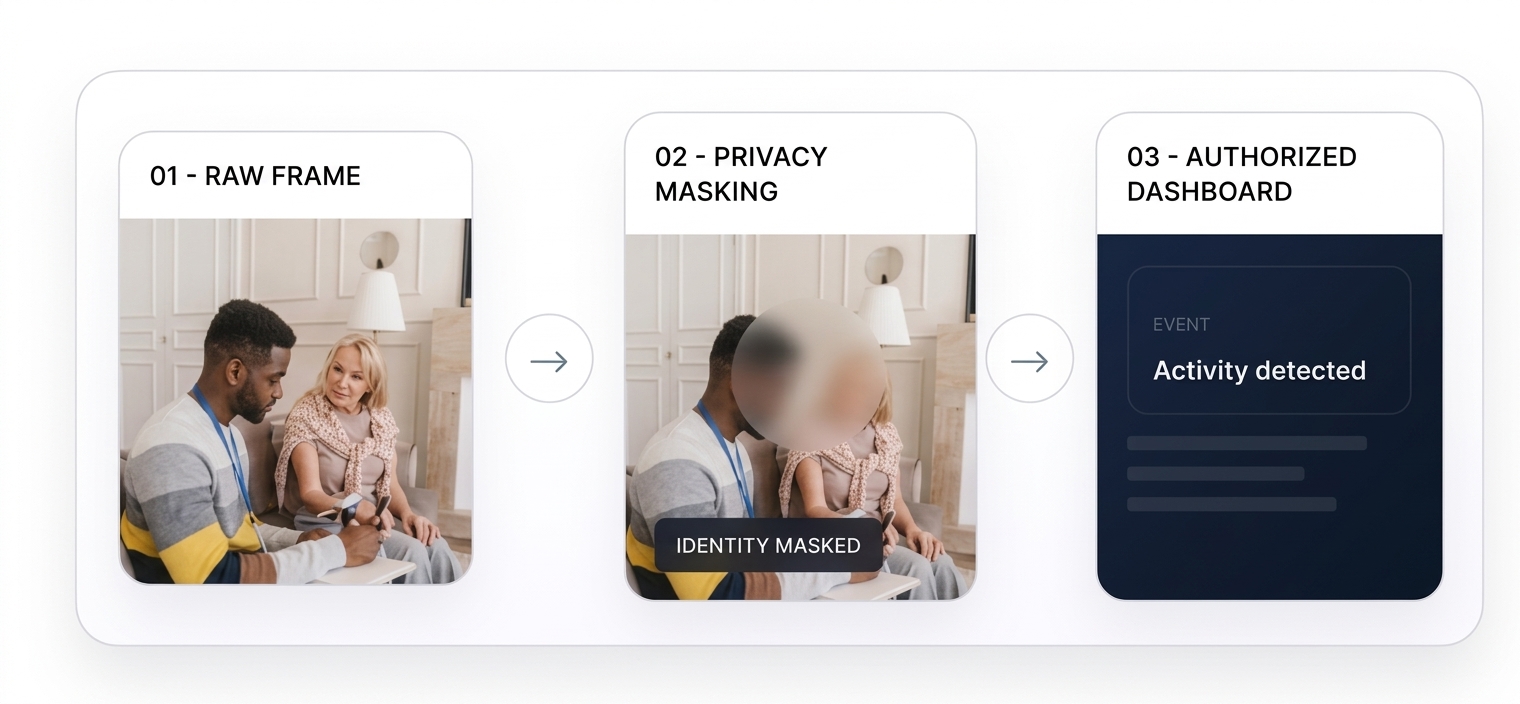
Privacy controls can be applied before imagery reaches the NAZR dashboard
Organizations define the monitoring policies appropriate for their environment
02 · Local processing
Keep processing inside your environment when required.
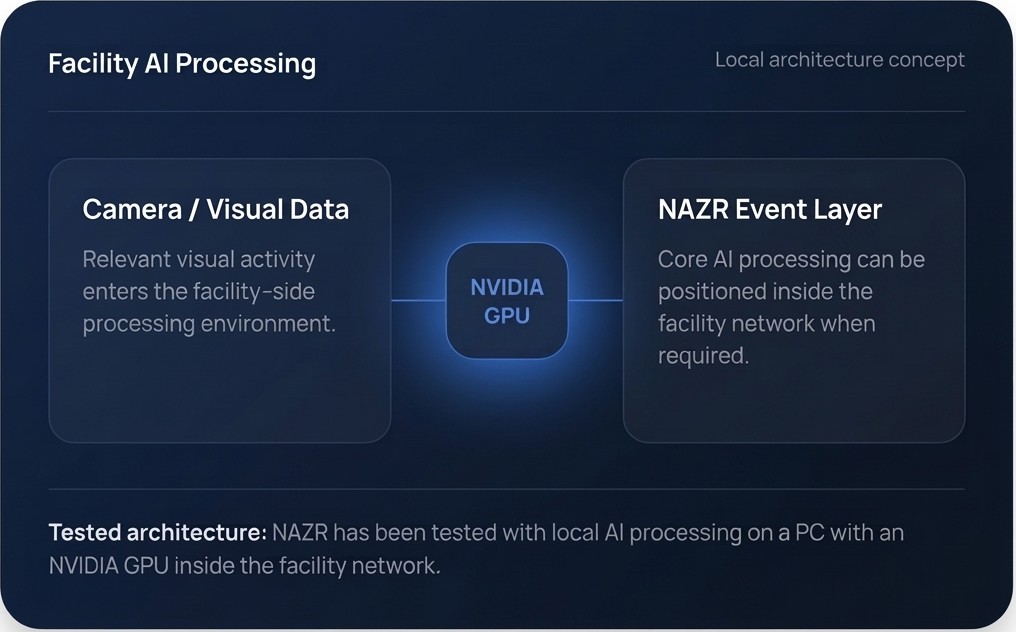
NAZR has been tested with local AI processing on a PC with an NVIDIA GPU inside the facility network.
The intended architecture can run core AI processing without an external Internet connection.
Cloud processing remains an option where centralized, scalable processing is preferred.
03 · Architecture choices
Choose the processing model that fits the environment.
Different environments may require different processing approaches. NAZR supports an architecture discussion around local and cloud processing.
Assisted Living
AI processing inside facility
Suitable for restricted environments
Core processing can operate without Internet
Cloud
AI processing using cloud GPU
Suitable for scalable centralized processing
Requires stable Internet connectivity
04 · Controlled access
Access should follow the role.
NAZR’s approach to controlled access is centered on authorized users, role-specific dashboards, facility-defined access, and event-focused review.
01
Authorized users only
Access is intended for people authorized by the organization.
02
Site assessment
We review room layouts, common areas, camera options, privacy requirements and workflow constraints.
03
Use case design
We define the first measurable use case, such as bed exits, wandering alerts or response-time analytics.
04
Pilot deployment
We configure the visual intelligence workflow, alerts, dashboard outputs and reporting process.
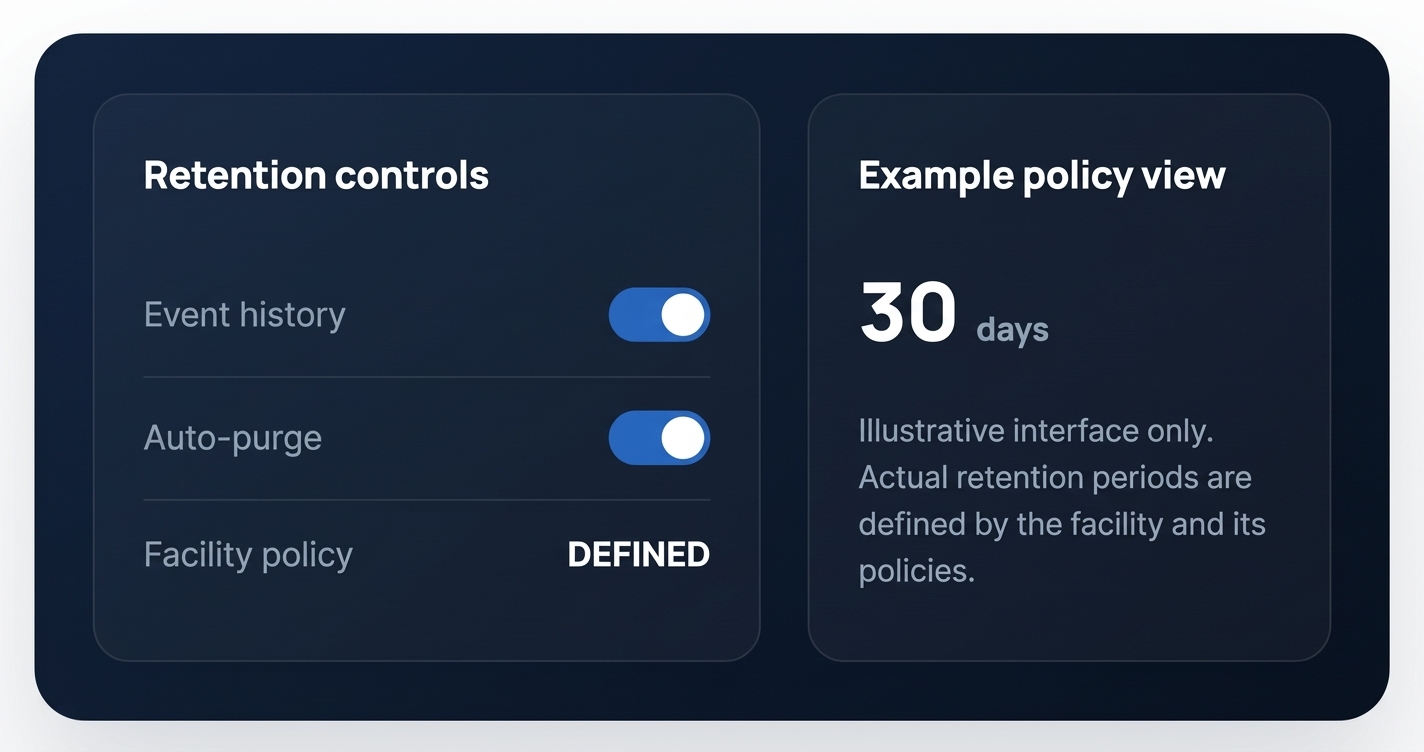
05 · Data retention
Your facility defines how long relevant data should remain available.
NAZR’s retention approach is based on facility-defined retention and auto-purge.
Facility-defined retention
Auto-purge according to the configured retention approach
Retention policies should reflect the organization's operational requirements
06 · Responsible use
AI supports care. Human judgment remains central.
NAZR is intended to support caregivers and care teams — not replace their judgment. AI-generated events should be interpreted in the context of the resident, environment, and organization’s care practices.
Human judgment stays central
Support caregivers
Use visual intelligence to surface relevant activity and help teams respond with greater awareness.
Keep humans in the loop
AI-generated events require appropriate care-team interpretation before action or documentation.
Define responsible policies
Monitoring policies should be established by the organization for its environment, roles, and care practices.
Privacy & Security
Design the right privacy model before you scale.
Start with your environment, access model, processing requirements, and retention policy. Evaluate NAZR around the use case that matters most.